I was side-lined last week by a terrible bout of vertigo. Only my second time experiencing this, and by far more intense than the first, I was forced to stop. And by “stop”, I mean completely take myself out of any engagement or activity at all. I had to avoid all movement, all work, phone use, television viewing, and at times, even talking…for 2.5 days! And just when I thought I was able to exist in the world again, it came back to remind me that my body wasn’t quite done resting yet. It took me another full day to feel “normal”.
Once I succumbed to this period of rest, I began to shift my perspective to see it as a much needed respite from my life. My body was literally forcing me to stop. In a world where busy-ness is often applauded and sometimes worn like a badge of honor, stopping is HARD to do. Or at least it is hard for me to do.
I decided to take advantage of this forced rest and dive in to learn how this time impacted me physically. I figured that I may as well use it as a learning experience. And luckily, my Oura Ring has metrics that show me the physiological impact of this rest.
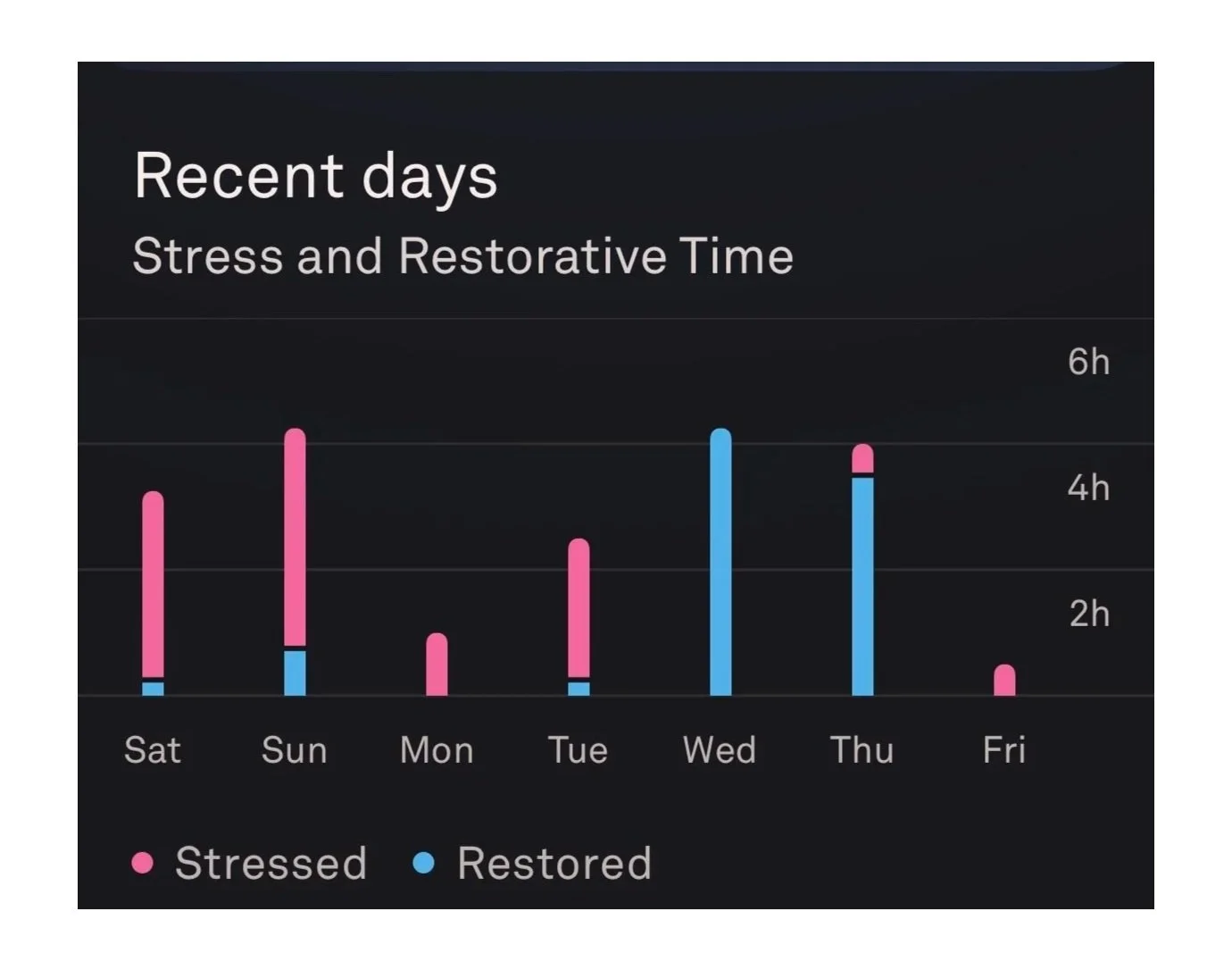
In this chart, pulled from my Oura app, the pink shows time of “stress” each day, while the blue is “restorative time”. The rest of each day is neutral, without any stressful peaks or restorative moments. The vertigo hit me on Wednesday morning, forcing me to stop moving completely that afternoon. It wasn’t until late Saturday that I was able to move freely, though I still moved slowly for fear that it would hit me again.
Here is how the Oura Ring recognizes each state:
Stress: Oura registers a period as "Stressed" or "Engaged" when it detects a lower-than-usual Heart Rate Variability (HRV), faster resting heart rate, and temperature fluctuations. This covers both mental strain and beneficial physiological stressors like workouts, cold plunges, or digesting a big meal.
Restorative Time (Restored): This is recorded when your body shifts into a calm, parasympathetic state. During these periods, your heart rate decreases, movement stops, and blood flow shifts toward your extremities, raising finger temperature slightly.
Simply being physically still (like watching TV or sitting on the couch) does not automatically count as Restorative Time. If your mind is active or you’ve recently consumed alcohol, your body can still be in a fight-or-flight "stressed" state.
So, while I practice yoga regularly and feel, in general, pretty un-stressed most days, it is clear from this snapshot that I don’t normally spend much time restoring my body and mind. It is in these restorative moments that our body systems are recharged - immune function improves, digestion improves, our bodies get a chance to take a big deep breath and reset.
I plan to use this experience with vertigo as a reminder to allow myself more consistent time for restoration, to slow down - and maybe even stop - every now and then. And, if I do this, then maybe, just maybe, my body won’t ever bring on vertigo and force my hand again.
How can you add more restorative time to your days?
Questions? Comments?